
The American academic landscape is witnessing a significant shift. As STEM (Science, Technology, Engineering, and Mathematics) careers continue to dominate the US job market—with the Bureau of Labor Statistics (2025) projecting over 1 million new STEM jobs by 2030—the pressure to excel in foundational “gatekeeper” courses like Advanced Calculus and Physics has reached an all-time high.
However, a concerning trend has emerged: more students than ever are struggling to keep their heads above water. In a 2024 survey of undergraduate engineering students, nearly 57% reported that the cognitive load of multi-variable calculus and quantum mechanics contributed to significant academic anxiety (Kalkbrenner et al., 2025). This isn’t just about “getting an A”; it’s about survival in a competitive, fast-paced educational environment.
The “Gatekeeper” Effect: Why These Subjects Are Different
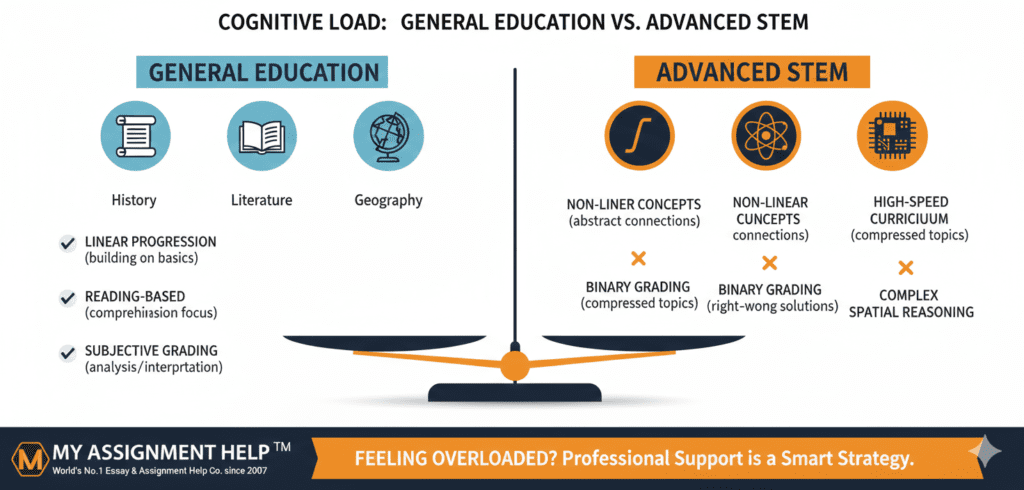
Advanced Calculus and Physics are not just extensions of high school algebra. They represent a fundamental shift from procedural learning (following steps) to structural understanding (applying abstract concepts to real-world variables).
For many US students, the transition to college-level physics involves a “perfect storm” of challenges:
- Abstract Complexity: Concepts like flux, divergence, and electromagnetic induction require a level of spatial reasoning that traditional classrooms often fail to cultivate.
- The Pacing Gap: While a high school course might spend a month on Newtonian mechanics, a US university “Physics 101” course often compresses this into two weeks.
- High Stakes: For students in pre-med or engineering tracks, a single “C” in Calculus II can derail an entire career path.
Faced with these hurdles, many realize that self-study isn’t always enough. When the textbook feels like it’s written in a different language and office hours are packed, the most logical step is to find an expert who can do my homework and explain the “why” behind the formulas. This strategic delegation allows students to focus on understanding core principles while ensuring their GPA remains competitive.
Data-Driven: The Rise of Academic Outsourcing in the US
According to recent institutional data, the demand for specialized STEM tutoring has increased by 42% since 2022. The reasons are multifaceted:
1. The Teacher Shortage and Instructional Quality
A 2025 report on the “State of the American Student” highlighted that many institutions are relying on overworked TAs (Teaching Assistants) rather than seasoned professors for lab and discussion sections. When the primary source of instruction is inconsistent, students naturally turn to professional services to bridge the knowledge gap.
2. The Mental Health Crisis
The “ESC” (Engineering Stress Culture) is real. Research published in PLOS Mental Health (2025) suggests that STEM students report higher levels of clinical depression symptoms compared to their non-STEM peers. By the time a student reaches a breaking point with a 20-page physics problem set, they aren’t just looking for answers—they are looking for a lifeline.
3. Financial and Career Pressures
With the average cost of US college tuition rising, the financial “ROI” of a degree is under scrutiny. Students often feel they cannot afford to fail a class they paid $4,000 to attend. This is where the choice to pay someone to do my homework becomes a pragmatic business decision for a student’s future.
Key Takeaways for Struggling Students
- Don’t Suffer in Silence: STEM burnout is a documented phenomenon in US universities.
- GPA Protection: Gatekeeper courses are designed to be difficult; using professional help is a common strategy among top-tier students.
- Focus on Concepts: Outsourcing the “grind” of repetitive problems allows more time for conceptual mastery.
- Time Management: Professional assistance provides the breathing room needed for internships and work-study jobs.
Frequently Asked Questions (FAQ)
Q1: Is it common for US students to seek help for Advanced Calculus?
Yes. Statistical evidence from 2024-2025 shows a significant uptick in students utilizing external academic platforms specifically for STEM subjects due to the accelerated pacing of the US curriculum.
Q2: Will using a service help me understand the subject better?
When used correctly, professional solutions serve as a “solved example” guide. Seeing how an expert navigates a complex physics derivation provides a roadmap that textbooks often omit.
Q3: How do I handle the high workload of Physics and Calculus simultaneously?
Many students use a “hybrid” approach: they attend lectures for the theory and use professional homework services to manage the heavy volume of weekly assignments, ensuring they meet deadlines without burning out.
About the Author: Sarah Jenkins
Senior Academic Strategist at MyAssignmentHelp
Sarah Jenkins is an educational consultant with over 12 years of experience in the US higher education sector. Holding an M.S. in Educational Psychology, she specializes in student retention and STEM curriculum development. Sarah has contributed to numerous journals regarding the “normalization of academic support” and works closely with the team at MyAssignmentHelp to ensure that student assistance remains high-quality, ethically grounded, and data-driven.
References:
- Bureau of Labor Statistics (2025). STEM Occupational Outlook.
- Kalkbrenner, M. T., et al. (2025). Supporting Mental Health Among STEM Students: The REDFLAGS Model. PMC Journal.
- Center on Reinventing Public Education (2025). The State of the American Student: A Crisis in Math.
- Machisi, E., et al. (2025). Examining the least preferred topics among advanced placement calculus students. Eurasia Journal of Mathematics, Science and Technology Education.