
Introduction
In recent years, many result-related terms have started appearing online without clear background or explanation. Users often come across these terms while searching for updates, numbers, or outcomes linked to local games or result systems. One such term that repeatedly appears in search results is chetak result arcarrierpoint.
At first glance, this term looks specific and structured. Because of this, many users assume it represents an official result source or a verified platform. However, online visibility alone does not confirm authenticity. This article aims to explain what this term actually represents, how it is used online, and what can realistically be confirmed. The purpose is simple: provide clarity, not promotion, and help users understand the reality behind the term.
Understanding the Term “Chetak Result ArCarrierPoint” as a Whole
The term chetak result arcarrierpoint is best understood as a combined search term rather than a formally defined entity. It brings together a result-related label (“Chetak result”) with a platform reference that users frequently see mentioned online.
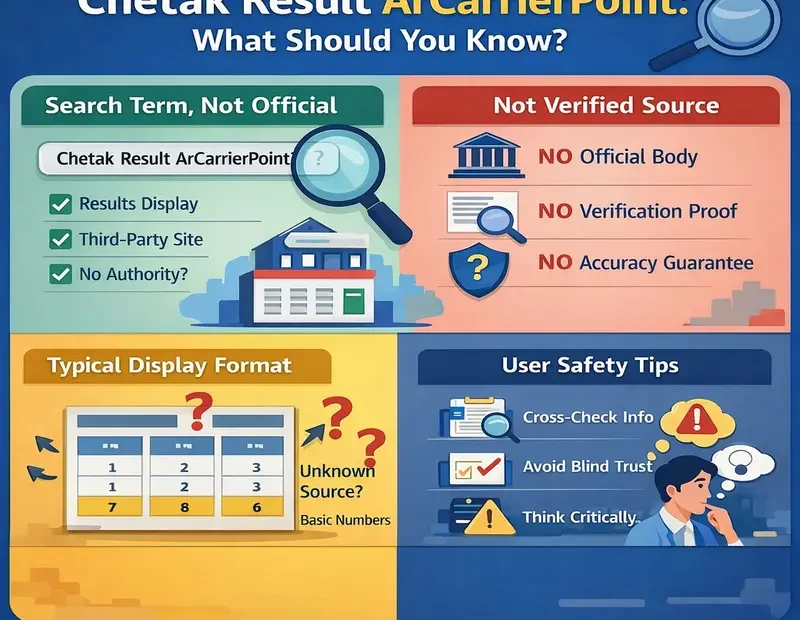
Many users interpret the term as one complete system. In reality, it does not represent a registered service, organization, or official authority. Instead, it reflects how users search for result information that is displayed on third-party websites. This distinction is important. A structured term can look official even when it has no formal recognition behind it.
How and Where This Term Commonly Appears Online
Most users encounter chetak result arcarrierpoint through search engines. It often appears in page titles, headings, or result listings on general informational websites. These pages usually display numbers or tables labeled as results, but provide little explanation about their origin.
Another noticeable pattern is repetition. The same term appears across multiple pages with similar layouts and similar wording. While this repetition increases search visibility, it does not increase credibility or clarity.
Because of this, users may repeatedly see the term without ever finding a clear explanation of what it actually represents.
What Users Are Actually Trying to Find Through This Term
User intent behind this term is usually straightforward. People are looking for a confirmed result, a reliable update, or a trustworthy source. Many expect the term to lead to an official announcement or an authoritative platform.
However, pages using this term often fail to explain where the data comes from or who is responsible for it. This gap between expectation and reality causes confusion and leads users to search further for verification. Understanding this intent explains why the term continues to attract attention despite limited clarity.
The Meaning of “Chetak Result” in Public Searches
On its own, the label “Chetak result” does not point to a clearly defined or universally recognized official system. In public searches, it is used broadly and inconsistently. Different websites may use the same label to describe different types of result content.
There is no publicly available documentation confirming “Chetak result” as a standardized or regulated source. Because of this, its meaning depends entirely on how individual websites choose to present it. This lack of consistency makes independent verification difficult for normal users.
The Role of ArCarrierPoint Within This Term
Within the term chetak result arcarrierpoint, ArCarrierPoint appears as a reference point rather than as a proven authority. Publicly visible information shows that ArCarrierPoint functions as a general informational website that displays various types of content.
There is no publicly verifiable evidence that ArCarrierPoint operates as an official result board or governing body. Its role appears limited to displaying result-style information rather than creating or officially validating it. For this reason, ArCarrierPoint should be viewed as a third-party display source, not as an original or authoritative provider.
Content Patterns Found on Pages Using This Term
Pages that use chetak result arcarrierpoint often follow similar content patterns. These include table-based number displays, short labels, and minimal descriptive text. In most cases, there is no explanation of methodology, source, or verification process.
The repetition of similar layouts across different pages suggests template-based publishing. While this approach helps with consistency, it does not help users verify authenticity.
A lack of contextual information is one of the strongest indicators that the content is informational rather than official.
Verification Check: Is There Any Official Backing?
When checking for official backing, several key elements are missing. There are no clear references to government departments, licensed boards, or regulated organizations connected to this term. No public documentation confirms official ownership or responsibility.
Additionally, there is no transparent explanation of how results are generated or validated. Without these elements, official verification is not possible. From a verification standpoint, the term lacks the signals typically associated with authoritative sources.
Why Search Engines Still Show Pages for This Term
Search engines display pages based on relevance, keyword usage, and user interest. The frequent repetition of chetak result arcarrierpoint across multiple websites increases its visibility in search results.
However, search ranking does not equal legitimacy. A page can rank well simply because many users search for the same term. This is why users should not rely on ranking alone as proof of authenticity. Understanding this difference helps users evaluate online information more critically.
Common Misunderstandings Around This Term
One common misunderstanding is assuming that any displayed result must be official. Another is believing that a platform name automatically indicates authority. Visibility and familiarity can create a false sense of trust.
These assumptions are natural but risky. Without verification, such interpretations can lead users to rely on unconfirmed information. Awareness of these misunderstandings is an important step toward safer online behavior.
What Can Be Confirmed Publicly
From publicly available information, a few things can be confirmed. Websites using the term exist, and they display result-style content. The term itself is popular in online searches and appears across multiple pages. These facts describe visibility and usage, not authenticity. They simply confirm that the term is active online.
What Cannot Be Confirmed Publicly
Several important aspects cannot be confirmed. There is no verified original source for the results, no guarantee of accuracy, and no evidence of regulatory oversight. There is also no clear accountability structure if information is incorrect. These limitations are important for users to understand.
Safety and Trust Considerations for Users
Users should treat content related to chetak result arcarrierpoint as informational only. Blind trust in unverified result data carries risks, especially when decisions depend on accuracy. A safer approach is to cross-check information, avoid assumptions, and rely on clearly identified official sources whenever possible. Developing verification habits helps users navigate similar terms more safely in the future.
How Users Should Properly Interpret This Term
This term should be interpreted as a search-driven reference, not as a confirmed result authority. It may help users locate displayed information, but it should not be treated as proof of authenticity. Using it for awareness or general reference is reasonable. Using it for final decision-making is not recommended without independent verification.
Final Conclusion
The term chetak result arcarrierpoint should be understood in its proper context. It is not the name of an official result system, nor does it represent a verified or regulated authority. Instead, it reflects how result-related information is searched for and displayed on third-party websites.
While pages using this term may show result-style data, there is no publicly available proof confirming an official source, accuracy guarantee, or regulatory backing. For this reason, the term should be treated as informational only and not as a confirmed or authoritative reference.
Users can avoid confusion by separating search visibility from authenticity and by relying on clearly identified official sources whenever accuracy matters.
Disclaimer
This article is written for informational and educational purposes only. It has no affiliation with any platform or service mentioned. No promotion, endorsement, or accuracy claim is made. Users are encouraged to verify information independently.
For more articles visit our website: Ukstate.blog